I Found a Baby Dove Bird What Do I Do

What Can I Feed Orphan Baby Wild Doves & Pigeons?
Ron Hines DVM PhD
 All Of Dr. Hines' Other Wildlife Rehab Articles
I dearest doves – their personality and their graceful dazzler. Quite a few accept come through my hands over the years. That has been primarily due to their poor nest building abilities. Once a few sticks have been carelessly crossed, doves and pigeons consider the job done.
Doves and pigeons are 1 of the few groups of birds that y'all are likely to meet in the USA, Canada or Europe that require a very specialized diet. While other baby birds are simply present insects and perhaps some of their parent's adult food by their parents, doves and pigeons ( columbine birds) that are raising offspring transform their ingather into a " milk " producing organ. Merely flamingos, penguins and parrots exercise something similar. (read here)
Lest yous take the word "milk" literally, cow or goat milk is NOT a suitable nutrient for doves or pigeons considering they both contain lactose carbohydrate (milk sugar) that doves and pigeons cannot assimilate. This sugar ferments in their digestive tracts causing bloat, diarrhea and respiratory distress that eventually leads to their expiry.
The percent constituents of dove milk are unknown. But dove milk, which is likely to be very like, is about 70% h2o. Of the remaining solids in it, virtually 53-58% is protein and 34-35% is fat. Very little carbohydrates ( including sugars ) are present. The actual percentages of the contents of the milks of all species of animals never remains constant. It vary over fourth dimension. Factors similar the fourth dimension of day, the diet consumed by the parents, the number of offspring beingness fed and the electric current age of the offspring all cistron into its composition. Luckily, the infant animals of all species have been given the flexibility to bargain with these variations. Of course, natural pigeon/dove milk also contains all the essential vitamins and trace minerals that the babies require. Every bit the baby doves or pigeons mature, partially digested grains are regurgitated into this mix as well.
If you have occasion to raise orphan doves or pigeons, in that location are many recipes that have raised them quite successfully. For fatty content, many recipes incorporate Nutrical ® and/or olive or vegetable oils. For protein some contain peas, hemp powder, or vegan soy products. Varying amounts of one or another homo or animal vitamin supplement also as digestive enzymes are often thrown in the pot for good mensurate. A pinch of this, a smidgen of that – God anoint Nature for being so flexible.
One commonly used recipe is called MAC Milk : 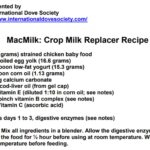
Many have plant that commercial parrot-raising formulas like Exact® work quite well for doves. Others in Europe use the Psittacus Catalonia Wildiet® formula.
My Technique:
Every yr I feed out babe doves and pigeons with a recipe I have prepared at home for many years. I chose the ingredients based on what I know about avian nutrition, on products that are are safe, economical and readily available to nigh anyone on brusk detect. This formula has worked well for me and I hope it volition piece of work well for yous likewise:

1) Pour 1.25 measuring cups of dry instant oatmeal into the empty cup.
2) To the oatmeal, add 1 loving cup of shaken Silk® unsweetened organic soy milk that has been microwaved for thirty seconds. Unsweetened, non-flavored Silk® milk adds poly peptide and, as importantly, calcium.
3) Mix them together well with spoon and microwave the mixture for 1 minute or as you would a cup of coffee.
4) Once the oatmeal and soy milk accept cooled, add the contents of ii big whole eggs and mix very well. Never microwave one time the eggs accept been added because the mixture will become lumpy and unusable.
As the birds attain maturity, reduced the number of eggs used to ane per cup. Oatmeal is deficient in Vitamin D3 . Egg yolk is a good sources of vitamin D3 and the egg whites are an additional source of balanced protein.
five) Mix well with a spoon until homogeneous.
6) Peak off to a comfortable tiptop with Silk® soy milk. Silk® soy milk has a short refrigerator shelf life. When I have only a few doves to feed, I freeze the soy milk in smaller pouches and thaw them as needed.
Let the finished mix sit in your refrigerator for an 60 minutes or so until it go polish and creamy and all small lumps have dissolved. Add a bit more soy milk if information technology is still too thick or if the babies are very young or if you doubtable that they are mildly dehydrated equally many fall-from the nest youngsters are. ( read here ) During the first week, the formula should drip from a syringe. As they become older, you can feed the formula thicker.
Bring your formula to room temp before feeding.
Afterward feeding, the cup goes on the upper shelf of your refrigerator until it is time to bring it to room temperature again for another feeding.
I fix no more I will employ up over a 48 60 minutes catamenia.
The most mutual cause of crop burn-throughs is feeding formulas that accept been unevenly microwaved and contain hot spots. So I e'er stir well later microwaving and later that, identify a dab on my wrist to be certain the temperature is safe.

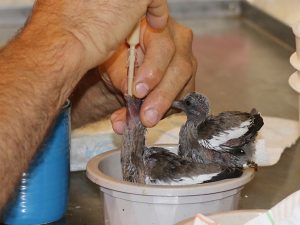
This mixture tin can be fed to babe doves and pigeons in many ways. I place it in a disposable pipette similar the one above which is also seen in view in the topmost photo layouts. With this pipette I identify a bit of formula inside the baby's rima oris with the bird allowed to swallow until its crop is moderately full. But never and then overfilled and tight that it extending upwardly the cervix. If placing your finger against the bird's neck causes regurgitation, you have given considerably also much at one feeding. Many smaller feeding, spaced throughout the day are always much safer than larger, exceptional feeding. Babies during their first week of life get fed four to five times. That is gradually reduced to three feeding and then to two. When the crop is empty and a little dent has formed at the neckband, information technology is fourth dimension to feed again. If the crop does non empty completely, you have not waited long enough or there is a health issue. After sundown, there is no need to feed.
Because I usually have a lot of mouths to feed and because infant birds can be messy, I often feed this formula to doves and pigeons using a 3ml dispensable syringe and a catheter (tube feed). I cultivate contacts at local hospital supply departments and enquire that intravenous catheter extension sets that take passed their FDA-mandated expiration date be set bated for me.
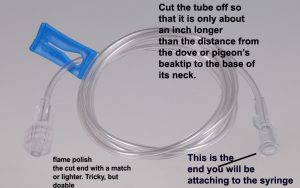
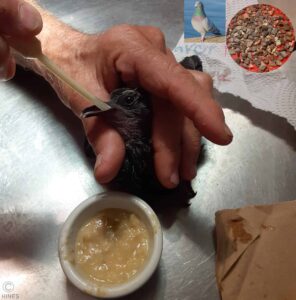
This is what they look like (you lot can enlarge all my images). You tin can run across one laying next to the scissors in the tertiary photo – before I have cutting it to length and some other already placed down the squab's throat. Once your 2d finger feels the end of the catheter where the bird's cervix enters its body, slowly express the majority of the formula. As I slowly withdraw the catheter, I get out a teaser corporeality of formula near the rear of the bird'due south mouth so it gets some sense of taste, pleasure and satisfaction out of the procedure. Over the 50+ years I have been tubing babe birds, I do non recall a single case where the tube entered the windpipe rather than the esophagus. Babe birds accept a very strong reflex when they gape or experience food in their oral cavity that locks their larynx shut. So a gently inserted tube going downwards wrong is quite unlikely. Nevertheless, watch an experienced aviculturist or wild bird rehabber tube feed before attempting to do and so unassisted.
Those Were Some Of Your Dos What Are Some Of Your Don'ts?
Don't put pressure level on the total or partially full crop or the bird might regurgitate and inhale formula.
Don't endeavour to pass a catheter or pipette unless the bird's head is in a star gazing position and the cervix extended.
Don't e'er endeavor to force a catheter or pipette downward that does not pass effortlessly.
Don't ever attempt to feed a bird that is not bright and alarm. They need subcutaneously administered fluids and glucose. Yous can read virtually that here.
Don't neglect good sanitation. If it would not pass a wellness inspector's muster in a restaurant setting, information technology's not a fit in a bird kitchen either.
Don't develop the habit of always feeding the pigeon or pigeon from the same side. That predisposes birds to developing scissor beak – a situation where the upper and lower beaks are misaligned. Y'all can enlarge this photo of a hand-fed nightjar that developed this trouble: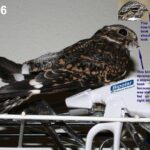
South Texas summers are quite hot and many of these infants are brought to me from far abroad. Almost are dehydrated. After windy storms that blow them out of their nests and drench them, many are chilled despite the hot weather condition. Neither dehydrated babies nor chilled babies absorb nutrients well. In those babies, the natural wave like move ( peristalsis ) that propels food downwardly their digestive systems function poorly or not at all. Tube feeding babies suffering that condition really speeds their demise because the formula ust putrefies and ferments in their crop. As I already mentioned, markedly dehydrated babies need subcutaneous and intramuscular fluids. (read here) Mildly dehydrated babies need their starting time few feedings to exist no more than warmed lactated ringers solution ( LRS ). They too need supplemental warmth if they are chilled. All wild creatures are masters at concealing stress, weakness and illness – until the very end. If the circumstances favor dehydration or chilling, just assume they are so, even if it is not outwardly apparent.
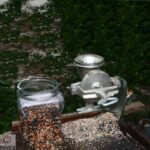
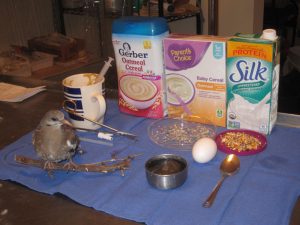
In one case only small tufts of down remain on the head, I brainstorm to identify dishes of water and seed grains in the bird's enclosures. A small rock ( or marbles ) placed in the water dishes ( as seen in the second photograph) help proceed the birds from turning the water containers over when they perch on them. Since I requite them no gravel to line their gizzards (gizzard gravel) at this historic period, I grind the grain mixture before I offer it to them. You can see the grinder I use in the photo above.
Be sure they are accepting mixed grains before you release them. A quality seed mix suggested for wild songbirds is fine. I add about a quarter amount of game bird (or turkey) starter crumbles to the mix. When whole seeds and grains are offered, I mix a scrap of fine stone grit in with their nutrient. The Hartz Gravel'n Grit™ is much too fine and goes right through them. Then using well-washed masonry pea gravel from a edifice supply or river, I first remove the effectively sand with a kitchen sieve. Then I remove the larger stones with a kitchen colander ( with ~3/16″ holes). Then I launder and re-wash what is left and let it dry. Ground poultry oyster trounce sifted in the same style works as also and provides the birds an boosted source of calcium. Their is an inset epitome top correct in the 4th photo at the top of this page of the proper size dust for a pigeon. The bird in that photo is already get-go to peck at whole grain.
My wife and I sometimes delay our release of doves beyond what my State allows. We don't releasing late summer babies close to the Texas pigeon hunting flavor. Others that stay longer are birds that face medical problems and need care. In both cases, I detect it wise to supplement a grain-based/seed diet with a modest amount of ground dog grub prepared with the meat grinder as seen in the photo.
Why Exercise Yous Apply A Homo Oatmeal-Based Diet?
Of all the cereal grains, whole rolled oats are amid the near nutritious. It is considerably more and so than corn or wheat. Instant baby oatmeal also blends readily with warm water. And because oats are practically gluten-complimentary, the formula is non as sticky as ane based on wheat would be. The make of instant oatmeal that I buy is pre-fortified with vitamins and calcium that the all infants including doves and pigeons demand. Because this product is marketed for children, liability problems dictate that the ingredients be of top quality. Products intended for homo consumption are considerably more than rigorously monitored for quality than diets intended for animals. For example, the FDA and USDA spend 24 times equally much money regulating human versus fauna food . Proper name make producers like Gerber accept the wherewithal to practice in depth analyses of their products -batch by batch. That is something that small niche pet food manufacturers generally do not accept.
Yous will run across ii brands of infant oatmeal cereal in second photograph at the pinnacle. At 1 time I purchased Parent's Selection™ because I noticed that it was all whole grain oat flour whereas the Gerber's was but partially whole grain oat flour. I suppose because of that, the poly peptide content of the Parent's Pick was listed as significantly higher. Merely I cannot say that I noticed any divergence in how the doves grew upwards eating one versus the other.
Why Practise You Add Raw Eggs To Your Diet?
ane) Egg increase the formula's fat/energy as well every bit its protein content
2) Raw egg albumin (the egg white ) as well makes my mix very "syringable". Lumpy diets are hard to force through a standard syringe. The lecithin and albumin in eggs is also an first-class lubricant – so I do not need to use products like KY jelly on the syringe catheter when I am using one. I don't feed soaked domestic dog or true cat chow to doves or pigeons. Only when I soak and blend dry kibble to feed or tube other types of wildlife, I have to ream out the tip of the syringe with an 1/eight" drill bit held in a vice-grip™ in order to get the slurry to pass through the tip freely.
three) Similar natural pigeon milk, raw eggs comprise important vitamins and antioxidants.
iv) One of the nearly important matter that raw eggs contribute and that is lost in heating and cooking are protective antibodies. Well-nigh of these egg antibodies are called IgY antibodies. They are plant primarily in the egg'south yolk. Although the chick was meant to absorb these antibodies from its yolk before hatching they remain protective in the intestine even when furnished afterwards hatching. These antibodies are non only constructive in decision-making intestinal bacteria, they are also though to control the growth of C. albicans, the crusade of avian thrush or candidiasis. Powdered egg will not do. Its antibodies were lost in processing.
One time the pigeon or dove hatches, these antibodies – which are also present in the parent'southward natural ingather milk are still important. But afterwards birth the antibodies are thought to only have the ability to act locally inside the squabs intestinal tract. Their molecules are too large to pass through the squab's intestinal lining intact. Their presence there is still quite beneficial. Information technology is not only the egg yolk that contains protective qualities – the whites do too ( lysozymes ).
Well, isn't there a danger in feeding raw eggs?
Yes but the risk is pocket-size. One out of x – 20,000 commercially produced eggs in the U.s.a. tests positive for salmonella. That take a chance can, perhaps be reduced even further by buying free-range chicken eggs. (read here)
Pasteurized, whole egg are maybe some other option. But I do not know if IgY antibodies survive the pasteurization processes used. If that processed did not accept the egg contents to over sixty degrees C (140 F) for ten minutes, these antibodies should take survived intact. (read here) I am still waiting to hear back from Davidson they never answered my email. 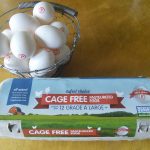
What Almost The Lack of Vitamin A In Eggs and Oats?
It is true that you will not find whatsoever vitamin A listed on oat cereal labels and a single large egg has only about ane tenth a man'south suggested daily vitamin A intake. But both egg yolk and oatmeal are rich in carotenoids that avian bodies have the power to convert into agile vitamin A ( retinol ). ( read here ) A source of either vitamin A or carotenoids are very important in maintaining a strong defense against infections and maintaining healthy skin and feathers.
Although some egg producers darken their egg yolks with bogus feed additives, more often darker orange/yellow yolks are a sign of higher carotenoid content. When given the opportunity, pick eggs with deepest orange yolks. It is always safer to provide carotenoids than it is to supplement with vitamin A from things like cod liver oil or bird vitamin tonics. That is considering likewise much vitamin A is toxic. ( read here )
What Are Plumage Stress Bars?
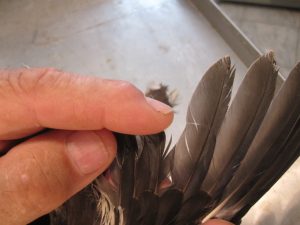
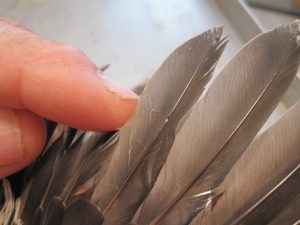
During the catamenia that a bird'due south feather is forming under its skin, the follicle that is producing the feather relies on a steady stream of protein building blocks obtained from the bird's blood stream (the amino acids needed to build feathers including β-keratin). If that steady menstruum of amino acids are interrupted – past a lack of appropriate food, a disinclination to eat or starvation – the plumage will no longer develop usually considering the bird tin can no longer produce the keratin proteins required to course the feather. When those nutrients again reach the proper level in its blood stream, plumage development returns to normal. So a careful examination of a bird's feathers gives you a look back into its past. In this item pigeon in the two photos above, I or one of my volunteers evidently missed a scheduled feeding while the plume I am pointing to was developing. That resulted in the narrow white line – like a scissor cut – present to the correct of my finger. Each incident of low claret amino acids causes a discrete line. You can meet that the integrity and strength of of the feather shaft was compromised at that indicate. With time, that plume will break at both points. You can view a more idealized image of stress confined here and read a scrap more about the problem and feathers in general here.
Is There Enough Calcium In The Diet Y'all Utilize?
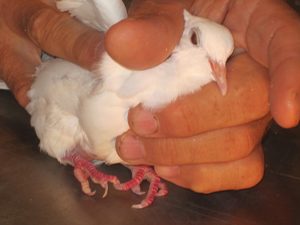
Some wildlife rehabilitators and aviculturists associate deformed legs and feet (such as in this deformed white Turkish pigeon ) with insufficient calcium in the diet during their growth period. I accept never seen bone or joint bug or flexible basic in pigeons, doves or parrots fed this formula, so I believe that its calcium content is acceptable. 8 grams of oatmeal contains about 4 mg of calcium and a 100 gm craven pullet requires about 130 mg of calcium per mean solar day. The soy milk I utilise is as well calcium-fortified.
When twisted or bowed foot or leg problems occur, it is more likely that they were caused by also smoothen or likewise apartment a cage floor. When a baby bird stands on a flooring that is basically flat, its toenails will brainstorm to curve sideways and exert a small-scale twisting force to the toes. With time, like a tree branch, the toes will twist to accommodate that force. Eventually, the pad of the foot will non rest apartment confronting the floor either. Those sort of problems can be prevented by furnishing the infant with a slightly indented twig mat similar to the mat that forms the fibroid flooring of a dove's natural nest. I use a shallow plastic dessert basin to maintain my artificial nest's shape. Paper towels or Kleenex™ will non due. They sideslip and slide. As the bird grows, twigs should always be bachelor that exceed the diameter of the bird'south clenched toes. You tin can read more about the problem, spraddle leg here .
Why Do Your Wild Doves Have White On Their Wings?
I live in the tropical Rio Grande Valley of Texas. Although some mourning doves are brought to me, more often they are tropical white-winged doves or tiny Inca doves .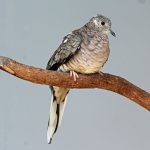
You are on the Vetspace beast health website
Source: https://vetspace.2ndchance.info/bird-health-articles/what-can-i-feed-orphan-baby-wild-doves-pigeons/

Post a Comment for "I Found a Baby Dove Bird What Do I Do"